Project Duration
Role
Tools
Executive Summary
Problem Context
Root Cause Analysis - Fishbone
After interviewing the Principal, 4 subject teachers, and 2 homeroom teachers, the key issues faced by SMK Nusantara Jaya were identified as follows:
1. Academic Aspect: Lack of Visibility into Performance Trends
Subject teachers record grades in personal Excel files or on paper. As there is no system that automatically compares performance trends, declines in student performance are only detected at the end of the semester (week 8 onwards). By the time homeroom teachers receive reports, student scores are already below the minimum competency standard.
2. Attendance Aspect: Delayed Response
Attendance data is also recorded manually. Homeroom teachers only become aware of problematic students after absences accumulate beyond 14 days—already exceeding the critical threshold. According to regulations, intervention should begin within the first 3 days.
3. Data Fragmentation: No Single Source of Truth
Attendance data is managed by administrative staff, academic performance data by subject teachers, and counseling records by the guidance counselor. There is no unified system that consolidates all information. Homeroom teachers must reconcile data from three different sources, spending 4–6 hours per week on administrative tasks alone.
Through interviews with homeroom and subject teachers, I identified that the main barrier to intervention is not a lack of concern, but rather static data and high administrative workload.
I then categorized the root causes into five areas:
Problem Categorization
Category
Root Cause
Process
Manual, batch-based data recording (monthly)
Data
Attendance & academic data not integrated
People
High teacher workload (multiple classes)
System
No automated risk scoring mechanism
Monitoring
No alert/notification system
Collectively, these factors cause risk identification to rely on lagging indicators (when conditions are already critical), rather than leading indicators (early warning signals).
Pareto Prioritization
From the identified root causes, I prioritized two with the highest impact:
Delayed detection (highest priority)
Lost intervention opportunities cannot be recovered once a student drops out.Absence of risk scoring (second priority)
Without standardized tools, risk assessment remains subjective.
These two issues contribute most significantly to the failure of the current system. Other problems (data fragmentation, manual monitoring, and teacher workload) are expected to be mitigated once the Early Warning System is implemented.
To validate these priorities, I analyzed historical data:
Validation with Historical Data
Delayed detection
Dropout students were identified after >30 days of absence—exceeding the 14-day critical threshold
No risk scoring
Out of 31 dropout students, only 6 (19.4%) received intervention before dropping out
Fragmented data
Homeroom teachers spend 4–6 hours/week reconciling data from three sources
This data confirms that delayed detection and lack of risk scoring are the primary priorities.
BPMN AS-IS: Current Process Mapping
I mapped the existing process using BPMN to identify specific failure points.
BPMN AS-IS Process Map

BPMN To-Be: Future Process Design
BPMN TO BE Process Map
Based on the AS-IS analysis, I designed a new process with five key improvements:

Change 1: Automated Risk Scoring Engine
Runs daily at 17:00 WIB
Calculates scores based on three criteria: Attendance (50%), Academic Performance (40%), History (10%)
Change 2: Three-Level Risk Classification
Score < 40 = High Risk
Score 40–65 = Medium Risk
Score > 65 = Low Risk
Change 3: Automated Alerts Based on Risk Level
High Risk → Notification to Homeroom Teacher + Guidance Counselor (urgent priority)
Medium Risk → Notification to Homeroom Teacher (normal priority)
Low Risk → No alert
Change 4: Mandatory Intervention Logging
Homeroom teachers must record actions and outcomes
Alerts are only cleared after action is recorded
Change 5: Periodic Reporting to the Principal
Weekly recap sent every Monday morning (as requested during the interview)
Decision Logic & Risk Parameters
Dual Path Risk Detection
The Early Warning System (EWS) applies a dual-path risk detection approach to identify at-risk students early. The system separates analysis into two main pathways:
Attendance Risk to detect patterns of absenteeism
Academic Performance Risk to monitor declines in academic achievement
Both pathways are analyzed in parallel before being combined in an AHP-based risk scoring system. This approach allows the school to understand whether risk stems from attendance, academic performance, or a combination of both.
Risk Scoring (AHP-Based)
Each risk indicator is calculated using the Analytical Hierarchy Process (AHP) to generate a student risk score:
Attendance (50%) as the earliest disengagement signal
Academic Performance (40%) as an indicator of learning difficulty
Retention History (10%) as a historical factor
The resulting score determines alert levels and intervention priorities. Scores are displayed directly on the homeroom teacher dashboard to support decision-making.
Combine Risk Signal
When attendance and academic risks occur simultaneously, the system automatically escalates the alert level. Example conditions include:
High absenteeism
Declining grades
History of grade retention
The system flags these students as priority cases and highlights them on the main dashboard.
Gradual Recovery Logic (Slow Decay Logic)
To ensure a more human-centered approach, the system applies a slow decay logic in risk scoring. When students show improvement—such as returning to school, stabilizing grades, or re-engaging in learning—the risk score decreases gradually over 14 days rather than dropping immediately.
This ensures:
Consistent intervention
Continuous teacher monitoring
Gradual recognition of improvement
Stability against short-term fluctuations
The EWS thus functions as a stable, adaptive, and development-oriented decision support system.
Ethical Foundation
System Philosophy: Data-Driven Care
This system is designed not as a surveillance tool, but as a welfare-first instrument. Recognizing that many students face vulnerabilities—such as living far from parents or economic hardship—absence is treated not as defiance, but as a signal of vulnerability requiring support.
The system architecture is grounded in four key principles:
Human-Centered Intervention
Data is used to initiate early dialogue and support, not punishment. Alerts are framed as signals of care, not fault-finding.Evidence-Based Decision Making
The algorithm never makes automatic academic decisions. It provides structured evidence to support fair and objective human judgment.Respect for Institutional Authority
Subject teachers retain academic authority, homeroom teachers coordinate support, and the Principal holds final decision-making authority.Data as Protection
Student data is used exclusively to safeguard their rights. Risk scores serve as navigation for protection, not as a tool for control or surveillance.
This system ensures that no student is “overlooked,” transforming raw data into meaningful, empathetic action.
System Architecture
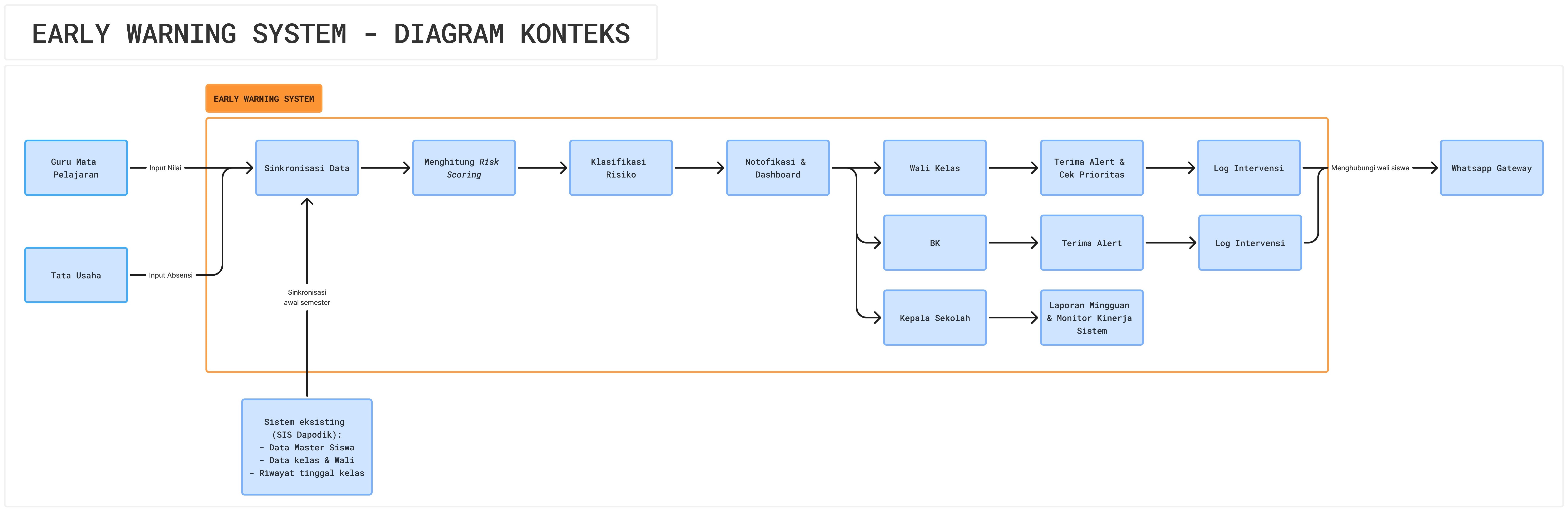
System Context Diagram
This diagram illustrates how the Early Warning System integrates with school records and interacts with external entities to monitor student conditions and initiate timely support.
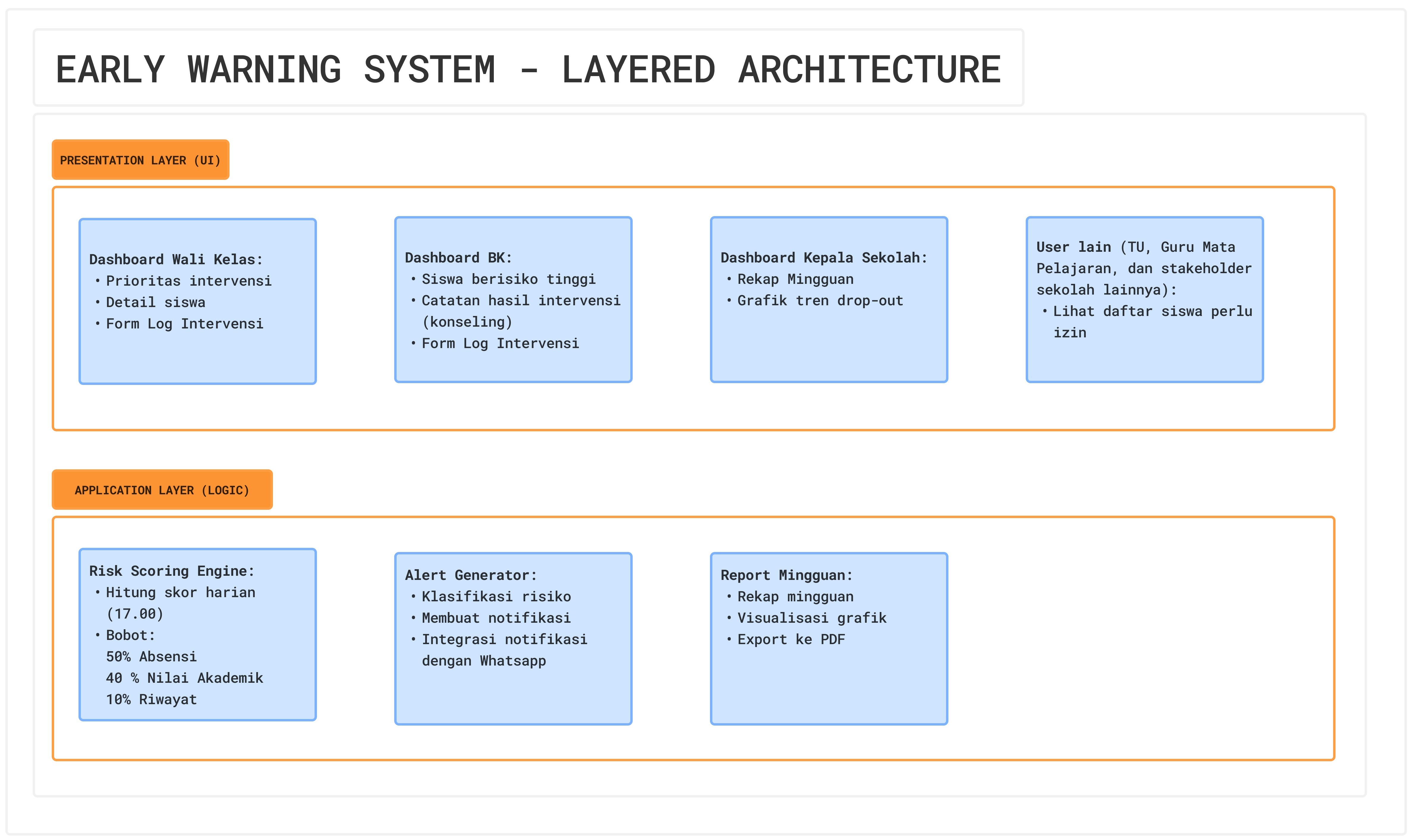
Layered Architecture
This diagram presents the layered architecture of the Early Warning System (EWS), separating the user interface from data processing logic. This enables homeroom teachers to easily monitor student conditions while the system automatically processes attendance and academic data into risk scores and intervention signals.