Duration
My Role
Tools
Executive Summary
Business Context
The Gap
Through interviews with 3 homeroom teachers and 3 subject teachers, I diagnosed the systemic failure:
"Subject teachers held the data, but Homeroom teachers held the responsibility."
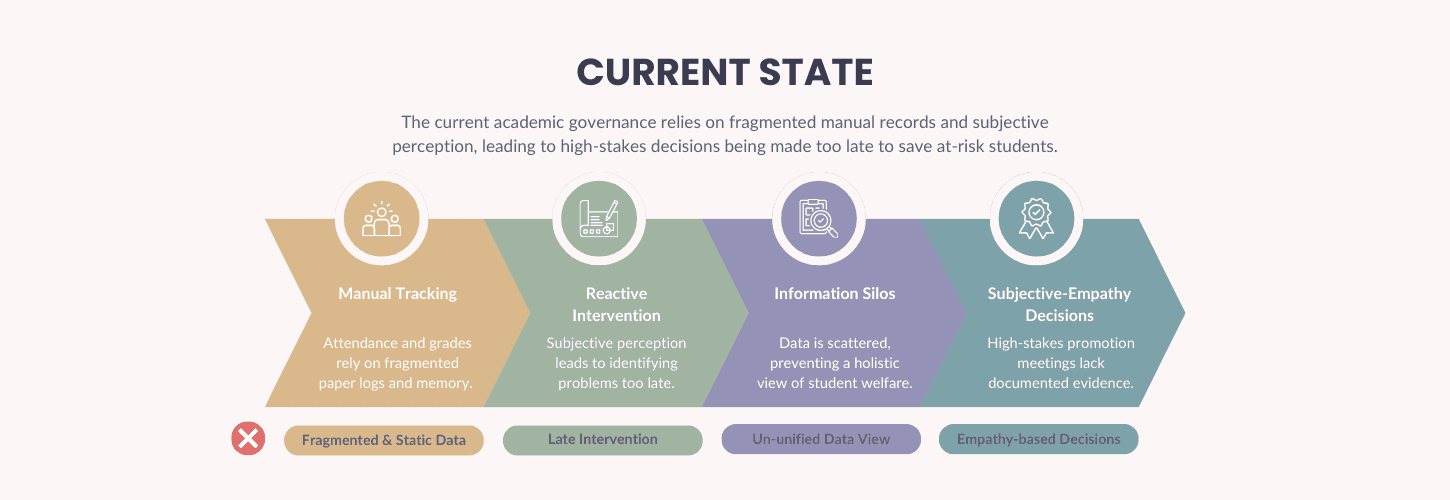
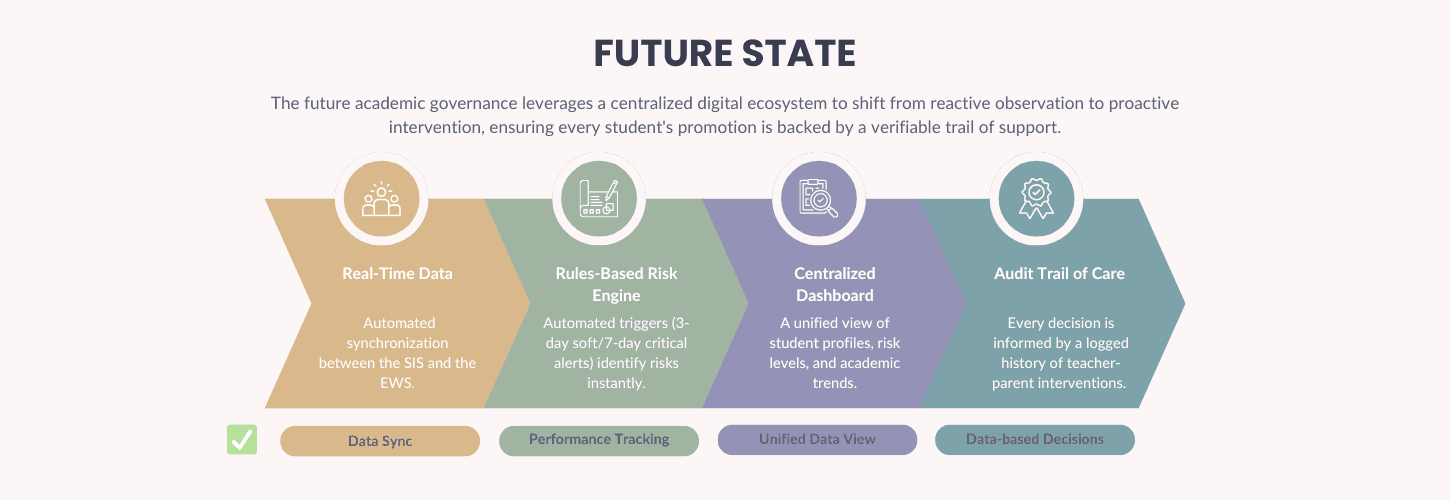
The gap was the lack of unified logic to trigger action. Data existed, but it was scattered—no mechanism connected the dots or alerted teachers before it was too late.
Current State vs Future State
Stakeholder Pain Points
Primary stakeholders and their pain points:
Subject Teachers
Students
Parents
Pain Points
Responsible for students welfare but no real-time data to act on
Holds grade data but no mandate to act on
Students facing personal hardship without anyone noticing
Being informed too late
Impact
Students at risk are missed
Student competence are often based on perception
Students graduate without core skills or drop out entirely
No chance to intervene
Secondary stakeholders are:
School Principal : Final authority over promotion and disciplinary decisions based on incomplete information
Foundation : Institutional owner; often risk-averse and resistant to operational change.
Education Authority : Sets standards but receives inconsistent reporting
System Logic & Rationale
Risk Scoring Algorithm
To move from subjective 'teacher intuition' to objective 'system signals,' I engineered a dual-path risk engine. This algorithm distinguishes between Presence Risk (Attendance) and Competency Risk (Academic) to ensure no student disengages silently.
Attendance Pattern
Description
Input
Risk Logic
Rationale
Attendance Pattern
Manual paper attendance log
3 consecutive absence days → Soft Warning
7 consecutive absence days → Critical Alert
Academic Performance
Description
Input
Risk Logic
Rationale
Academic Performance
Daily quizzes
Subject assignments
Final exam results
Consistent low scores (below minimum competency criterion/KKM) triggers a "Soft Warning"
A drop of >20% in main subject average scores over a 3-week window triggers a "Soft Warning"
Scores falling below the minimum competency criterion/KKM in more than two core vocational subjects trigger a "Critical Alert"
Competency risk isn't just about 'low grades'—it's about velocity. By tracking performance decay instead of just static averages, we catch students who are struggling in mind, allowing for early support.
Design Choice: Slow Decay Logic
To ensure a humane approach, risk scores recover slowly over 14 days when positive behavior returns. This prevents 'score volatility' and ensures students are rewarded for sustained improvement rather than just a single day of attendance.
Technical Specs
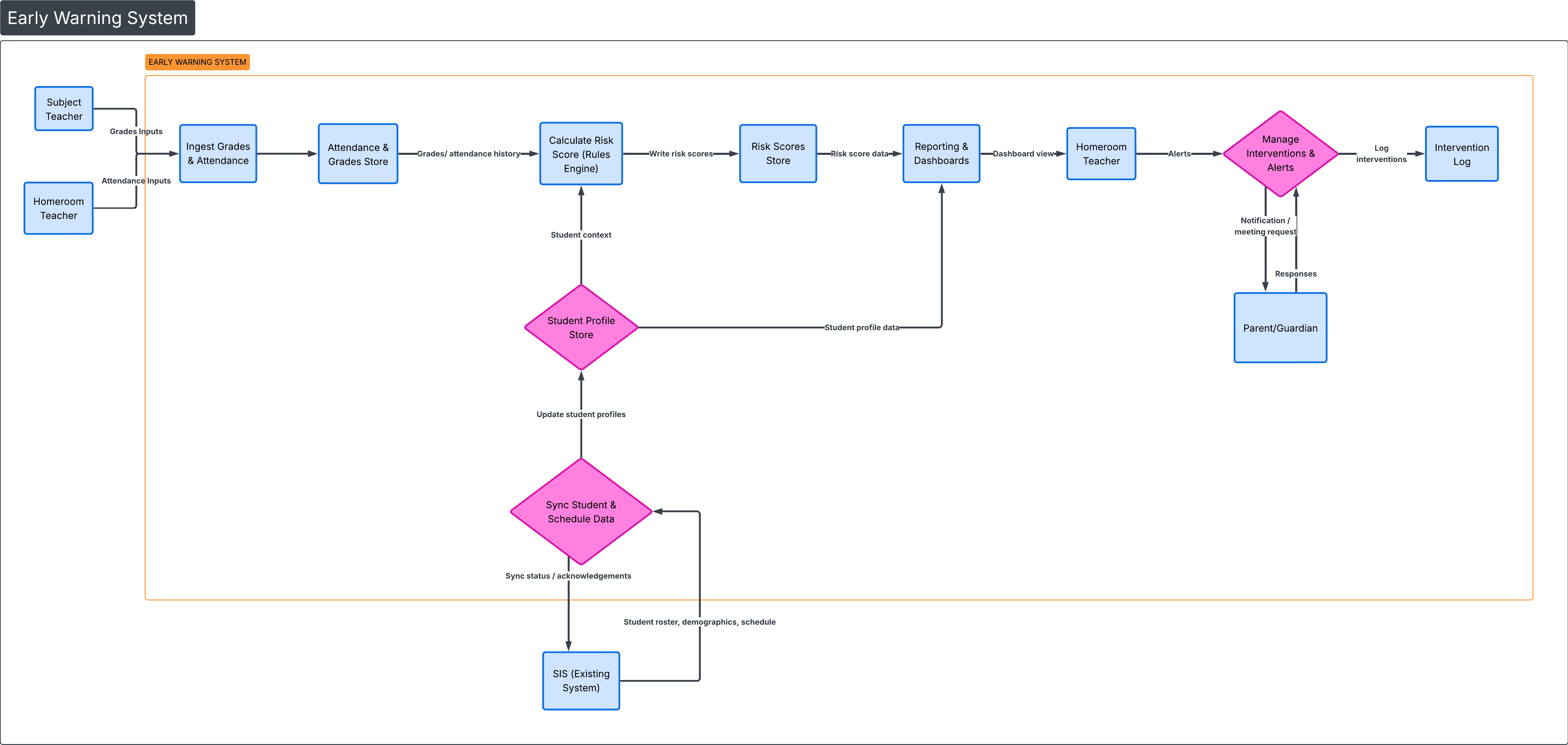
System Context Diagram
The Ethical Foundation
Design Principles
This system was explicitly designed to support—not override—human judgment. It transforms data from a tool of surveillance into a mechanism of care, specifically engineered for the unique vulnerabilities of students in low-income or rural contexts.
The "No-Direct-Bot" Rule: To maintain trust, the system never contacts parents directly. All communication is mediated by the Homeroom Teacher to ensure that automated alerts are delivered with human empathy and context.
Four Pillars of Architectural Ethics
Principle
Intervention, Not Punishment
Care-Oriented Data Use
The system aggregates signals but never automates promotion decisions
Subject teachers retain academic authority; Principals retain final say
Data is treated as a protective tool for student rights
Human Outcome
Focus shifts from "strict discipline" to "earlier care"
Decisions remain grounded in structured evidence, not algorithms
Technology respects and reinforces existing institutional authority
Institutional judgment held without compromising student privacy
The Handoff
To move from Framework to Function, I am handing off these requirements to the design phase with three core objectives:
Objective 1: Reduce Cognitive Load – Transform complex risk scores into a "Calm UI" that highlights only what is urgent.
Objective 2: Frictionless Intervention – Integrate communication tools (WhatsApp) directly into the workflow to ensure alerts lead to action.
Objective 3: Adoption over Complexity – Ensure the interface is optimized for low-end mobile devices and varying levels of digital literacy.